

Shopping Mall or Standalone Premises: Where Is It More Profitable to Open a VR Park?
Choosing a location is one of the decisions that has the greatest impact on the future performance of a VR park. You can choose a spacious standalone building, gain a prominent sign and full control over the space. Or you can locate the park in a shopping mall and immediately be surrounded by a large number of potential visitors.
At first glance, the choice seems simple: a shopping mall provides traffic, while a standalone location offers freedom and potentially more flexible terms. In practice, however, it is more complicated.
VR ARENA’s international network experience shows that both formats can work successfully. In Georgia, for example, the first VR ARENA location opened in a standalone building in Tbilisi, and just six months later the partner launched a second location in a shopping mall. A third venue was then planned for one of Wendy’s prime locations. In other words, within the same business, the entrepreneur consistently used three different location formats.
So the question should not be framed as “shopping mall or standalone premises?” but rather: which specific location will give the VR park access to the right audience and allow it to build sustainable unit economics?
Start with the customer, not the premises
One of the most common mistakes when choosing a location is to first find an attractive or inexpensive property and only then try to figure out where the customers will come from.
For an entertainment business, the logic should be reversed. First, you need to define the core audience:
- families with children;
- teenagers;
- groups of friends;
- corporate clients;
- schools;
- tourists;
- walk-in visitors;
- residents of nearby neighborhoods.
For a VR park, families are especially important because birthday parties and group events can account for a significant share of demand.
VR ARENA’s experience provides a good example: when evaluating new locations, partners look not only at the property itself but also at the concentration of families around it. One practical approach is to study a map of schools in the area. A large number of nearby schools can indirectly indicate a high concentration of families with children. But even that is not enough: the purchasing power of local residents and the actual accessibility of the location must also be considered.
This is why a well-known shopping mall does not automatically make a location a good one.
In our experience, there was a case where a venue opened in a popular shopping mall, but there were almost no schools nearby and the concentration of families was insufficient. The location was later closed.
The conclusion is simple: traffic should not just be high; it should be relevant to your product.
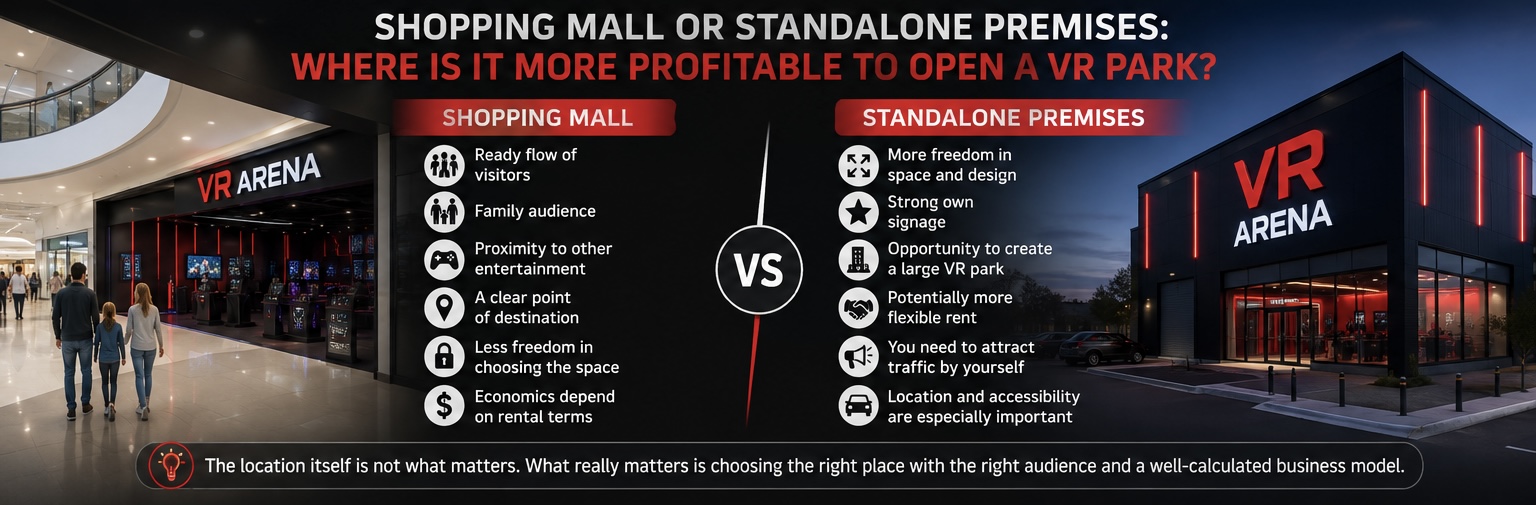
What a Shopping Mall Can Offer

The main advantage of a good shopping mall is an existing flow of people.
Some visitors do not come specifically for VR. They may arrive to shop, go to the cinema, a restaurant, bowling, or another attraction, notice the VR park, and become interested.
For a new business, this is especially important: there is no need to explain from scratch where customers should go or why they should visit that particular area. The customer is already nearby.
A good example of this approach comes from VR ARENA in Italy. There, the growth model was based not on building standalone VR parks from scratch, but on integrating VR arenas into existing entertainment centers, bowling venues, and other businesses with an established customer flow.
Over two years, 10 arenas measuring 8×8 and 10×10 meters were opened in Italy. None of them was a standalone greenfield project: all were integrated into existing entertainment centers.
According to data from these locations, after adding VR ARENA, attendance and revenue at the existing venues increased by an average of 15–20%. One arena hosted around 120 gaming sessions per month and generated approximately €7,000–10,000 in additional monthly revenue, with an average price of €20 per person and teams of three to four players.
It is important to interpret this case correctly. It does not prove that every VR park in every shopping mall will automatically achieve the same results. In Italy, VR was added to already operating entertainment venues with an existing customer base. It was the presence of ready-made traffic that reduced launch risk.
For an entrepreneur, this demonstrates one of the key advantages of a shopping mall or an operating entertainment center: part of the demand is already nearby.
Shopping Malls Are Especially Attractive for a Family-Oriented Format

If the business focuses on birthday parties, family visits, and group events, a shopping mall can offer another advantage: for families, such a trip naturally fits into their usual leisure routine.
Cafes, restaurants, shops, a cinema, and other entertainment options can all be located in the same place. This allows VR to become part of a longer visit.
A child comes to the VR park for a birthday party, the parents remain in the shopping mall, and the family goes to a restaurant after the game. Or the opposite happens: someone comes to the mall for another reason, notices the venue, and decides to learn more about it.
For a VR business, this also matters because a first visit does not always begin with a pre-planned purchase. Being able to see the arena in person lowers the barrier to trying the product.
In Turkey, VR ARENA’s experience highlighted the importance of visibility. After a prominent sign was installed at one of the new locations in Antalya, people began coming in even while construction was still underway. In the same experience, family and tourist traffic, visibility, car access, and parking were all identified as important location factors.
This is where a shopping mall can often be a strong format: it is easier for a potential customer to discover a new type of entertainment by chance.
But the word “often” matters. A poor spot inside a good shopping mall is still a poor spot.
The Other Side of Shopping Malls
A shopping mall should not be evaluated solely by the number of visitors.
Before signing a lease, you need to understand:
- where exactly the premises are located inside the shopping mall;
- whether the target audience actually passes by;
- how visible the entrance is;
- whether prominent wayfinding and exterior branding are allowed;
- how easy it is for customers to find the venue;
- whether there is enough space for both the gaming and guest areas;
- whether the geometry of the premises is suitable;
- whether birthday parties can be hosted comfortably;
- whether the rental economics match the potential revenue;
- what additional charges are included in the lease;
- what restrictions the property itself imposes.
We do not have verified data that would allow us to state that rent in a shopping mall is always more expensive than in a standalone property. It depends on the country, city, specific property, and lease terms.
For this reason, comparing options only by cost per square meter is incorrect.
A more expensive location may turn out to be more profitable if it provides the right customer flow and reduces dependence on paid marketing. Conversely, inexpensive premises can become an expensive mistake if the business has to keep buying additional traffic just to fill the venue.
When a Standalone Location Becomes a Strong Option
A standalone location creates a different development model.
In this case, the VR park itself becomes the destination: people travel there specifically for a game, a birthday party, or an event.
This format can be convenient when an entrepreneur needs a large area, several gaming zones, a spacious waiting area, party rooms, or the ability to build a larger entertainment center.
A standalone venue also provides greater control over how the property looks inside and out. Street visibility becomes especially important: the facade, signage, and a clear entrance begin to perform part of the marketing function.
Our experience shows that the standalone format can work very well.
The first Georgian VR ARENA opened in a standalone building in Tbilisi. Just six months after launch, the partner opened a second venue, this time in a shopping mall.
In the case described, average monthly revenue at the Georgian locations was around $17,000 per venue, with net profit of approximately $4,000. The financial model projected payback in roughly two years, although the business had not yet been operating for two full years at the time the case was prepared. Investment in the first locations ranged from $80,000 to $100,000, depending on the size of the premises and the number of gaming zones.
This example is important because successful expansion did not happen within a single type of real estate. First came a standalone building, then a shopping mall, and then a project inside an established popular location.
In other words, the entrepreneur was not looking for an “ideal type of premises,” but for new points of contact with the target audience.
The Main Risk of a Standalone Location Is Choosing the Wrong Area
While a shopping mall at least has its own traffic, a standalone venue depends much more heavily on the surrounding area, visibility, and the business’s ability to attract customers independently.
It is especially risky to build the entire model around a single audience.
VR ARENA has experience with a location in Isparta, Turkey, that was aimed primarily at students. When students left during the summer, the venue became unprofitable, and the investment model performed below expectations. With that experience in mind, the partner later noted that they would not choose the same type of area for a similar launch today.
The practical lesson matters more than the specific city.
If the location depends only on:
- students;
- the tourist season;
- office workers;
- residents of a single small residential complex;
- one large corporate client,
the business becomes too sensitive to changes in the behavior of that audience.
A strong location should rely on several sources of demand at once. For example: families from nearby neighborhoods + schools + birthday parties + groups of friends + corporate events.
What Matters More: a Shopping Mall or a Good Area?
If you are choosing between a weak shopping mall in the wrong area and a visible standalone location close to the target audience, the fact that one address happens to be a “shopping mall” solves nothing.
And the reverse is also true: a large, attractive building with low rent can be useless if it is inconvenient for families with children to reach.
Across VR ARENA’s international experience, several factors stand out when evaluating premises.
1. Family Audience
If a significant share of the business is built around birthday parties, families with children should either live nearby or visit the area regularly.
This is why we recommend analyzing residential neighborhoods, schools, family-oriented shopping malls, and other places where the target audience is concentrated.
2. Purchasing Power
The number of residents alone is not enough.
In different parts of the same city, audiences can vary significantly in their willingness and ability to spend regularly on entertainment. In Turkey, this factor was considered separately when comparing areas of Antalya.
3. Visibility
For a standalone building, a clear facade and prominent signage are especially important.
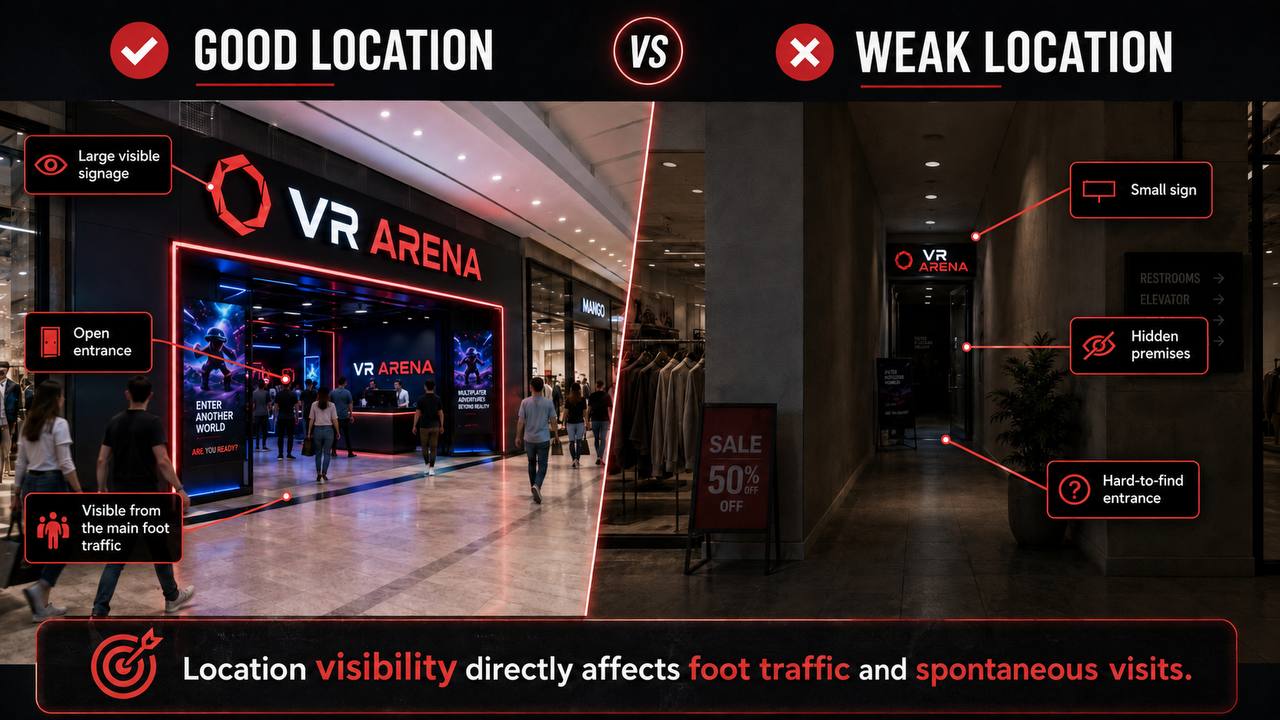
But visibility should not be ignored inside a shopping mall either. A unit in a remote corridor may receive completely different traffic from a location near the cinema or food and restaurant area.
4. Accessibility
You should literally walk through the customer journey: where will they park? How will they find the entrance? Can a parent comfortably bring a group of children? Will your team have to explain directions over the phone to every second visitor?
In our experience, car access and parking were specifically considered when evaluating locations, although it would be incorrect to claim that parking is mandatory for every VR arena.
5. The Premises Themselves
A VR park needs more than the right number of square meters.
You need to check whether the gaming zones can be placed without structural obstacles and whether there is enough space for reception, guest waiting, events, and staff operations.
An attractive rental rate means little if half of the premises cannot be used efficiently.
Do Not Evaluate a Location by Rent Alone
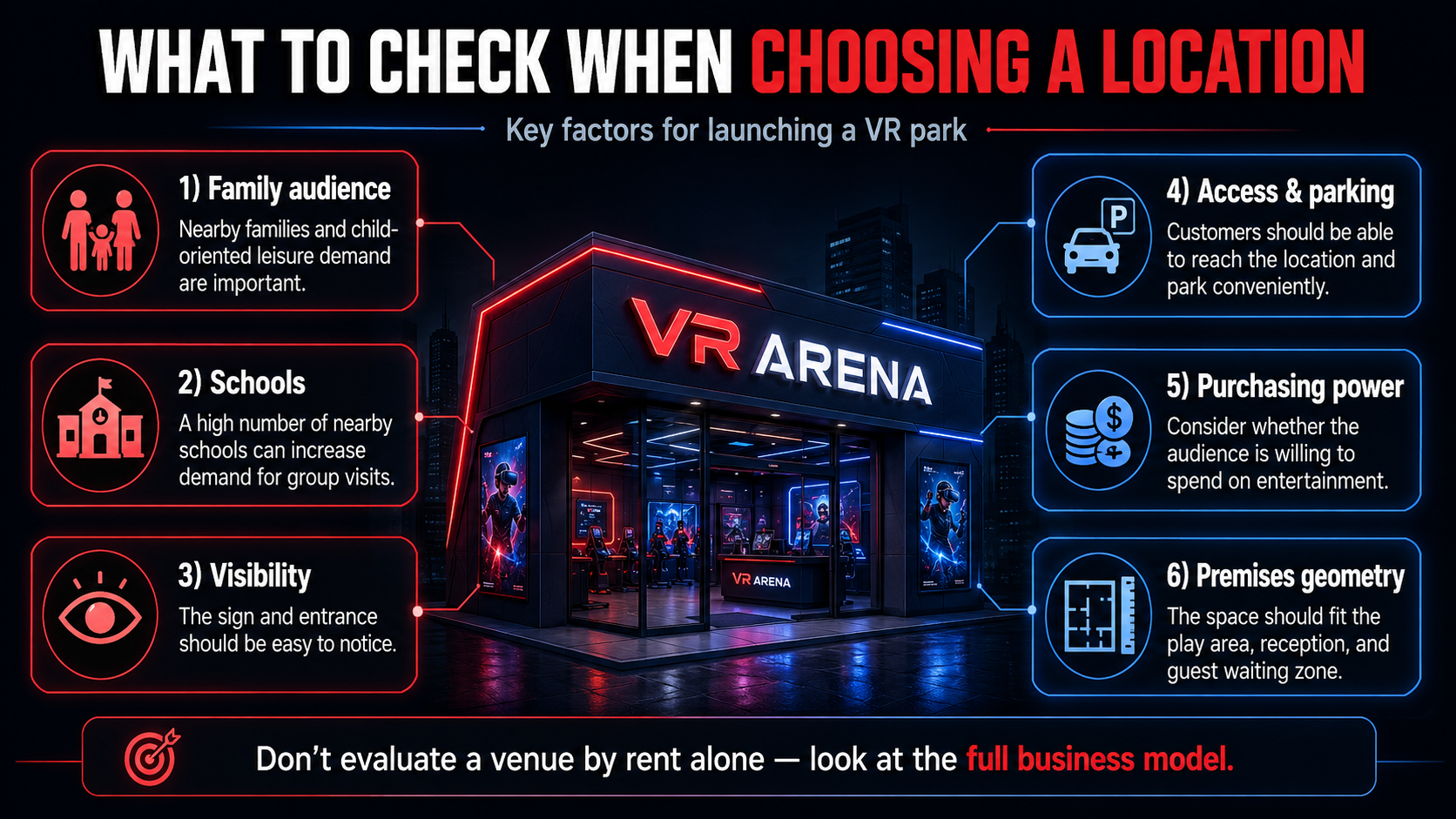
The lowest rent does not necessarily mean the most profitable location.
When comparing two properties, we recommend looking at the entire business model.
Option A: Shopping Mall
Rent is higher, but there is an existing family audience, a familiar destination, parking, and an opportunity to acquire some customers directly from the property’s traffic.
Option B: Standalone Premises
Rent is lower and the space is larger, but the venue must build its own visibility and attract a sufficient number of customers independently.
Which option is more profitable? It is impossible to answer without doing the numbers.
For each location, you should forecast separately:
- potential number of visitors;
- number of birthday parties;
- group events;
- corporate sales;
- average check;
- weekday occupancy;
- weekend occupancy;
- marketing expenses;
- rent and operating expenses;
- renovation and launch costs;
- initial investment;
- payback period.
Only after that can the two properties be compared.
This is why a property with higher rent can sometimes be economically stronger, while a property with a lower rate can be weaker.
Standalone Format, Shopping Mall, or a Venue Inside an Existing Business?
In practice, the choice is even broader.
VR ARENA’s experience shows at least three workable models.
First — a Standalone VR Park
Suitable for a project that wants to become a destination in its own right and independently control customer traffic.
Second — a VR Park in a Shopping Mall
Suitable when the shopping mall provides the right family or entertainment audience and the rental economics allow for a sustainable model.
Third — Integrating a VR Arena into an Existing Entertainment Business
VR ARENA’s Italian experience shows that this format makes it possible to use the existing audience of a bowling center, go-kart venue, or entertainment center and generate additional revenue without launching a separate large venue from scratch. In Italy, the average cost of launching such arenas was $20,000–25,000 because the project involved adding a VR zone to an operating business rather than building a full-scale standalone VR park.
These are fundamentally different models, and comparing them only by rent makes little sense.
How We Recommend Choosing a Location
Before making a decision, a prospective VR park owner should conduct a simple audit.
First, Study the Area
- Who lives nearby?
- Are there families?
- Are there schools?
- Is there tourist traffic?
- What is the purchasing power of the audience?
- What entertainment options already exist nearby?
Then, Study the Specific Property
- How visible is it?
- How will customers get there?
- Is there a convenient entrance?
- Is there enough space?
- Can group events be hosted?
- Is there room for expansion?
Then Calculate the Economics
Do not ask only: “How much is the rent?”
A much more useful question is: “How much will it cost to bring the required number of customers to this location?”
Only then should you compare a shopping mall with a standalone property.
So Which Option Is More Profitable?
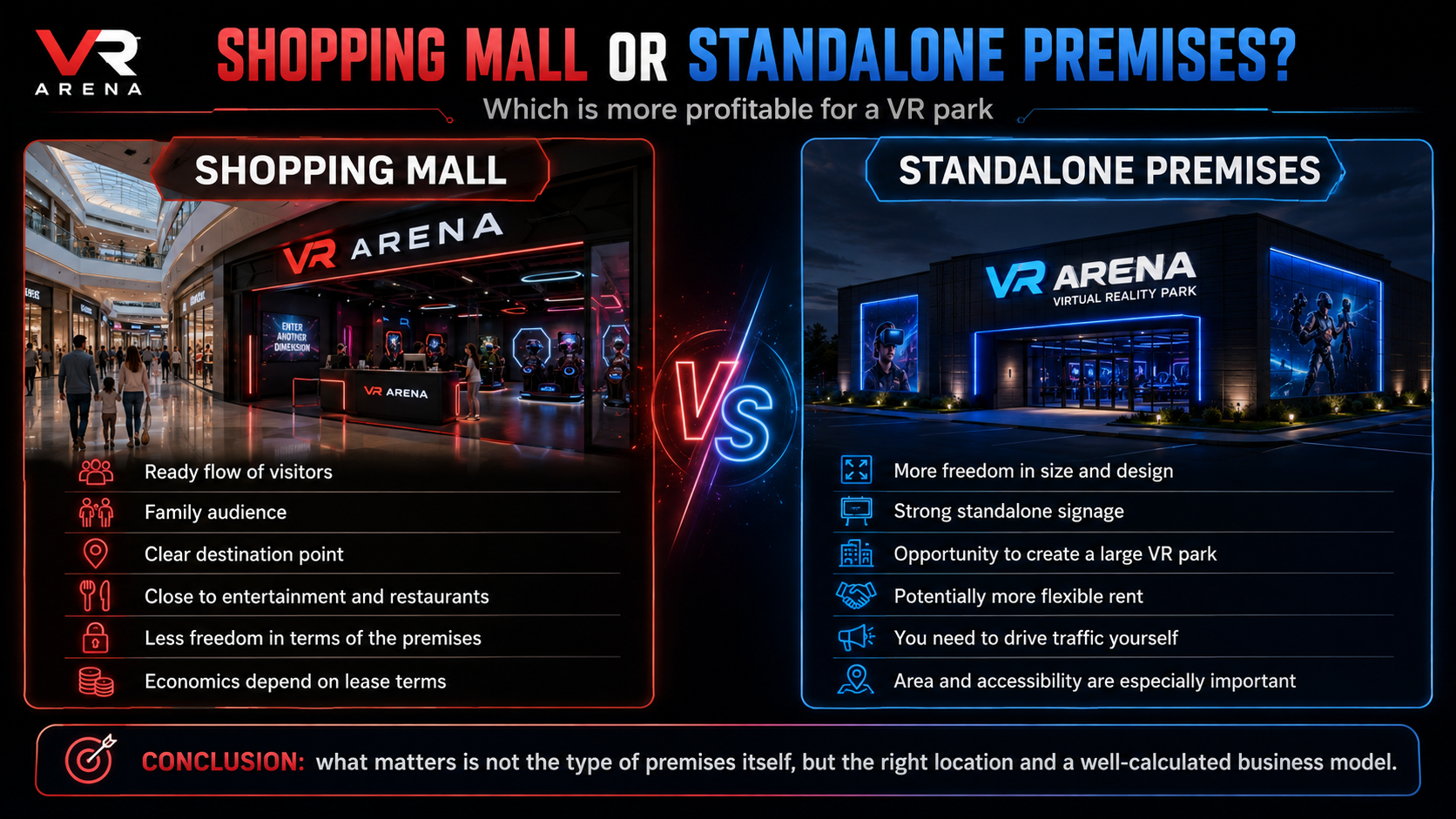
A shopping mall can be more profitable if it genuinely provides the right audience, strong visibility, and an existing flow of visitors. For a new business, this can reduce dependence on generating traffic entirely on its own.
A standalone location can be more profitable if it is in a strong area, offers good access, has a visible facade and sufficient space, and the savings on rent genuinely offset the additional cost of customer acquisition.
At the same time, VR ARENA’s experience shows something else that matters: a successful network does not have to commit to only one format.
In Georgia, expansion moved from a standalone building to a shopping mall and then to a venue inside an already established location. In Italy, the model is based on integrating VR into existing entertainment centers. In Turkey, experience highlighted the risks of relying too heavily on a single type of audience. All of these examples lead to the same conclusion:
What is profitable is not the shopping mall or the standalone building itself. What is profitable is a well-chosen location with the right audience and carefully calculated economics.
This is why, when launching a VR park, the VR ARENA team considers the premises not separately from the business, but as part of the entire model: the audience, venue format, gaming space, marketing, and future occupancy.
A good location should do more than simply fit a VR arena. It should help the arena sell.

