

From Idea to First Customers in 30 Days: A Step-by-Step Plan for Launching a VR Arena
When an entrepreneur first considers opening a VR arena, the project can easily look like a long sequence of tasks: find premises, renovate them, purchase equipment, install software, hire staff, launch advertising, and only then start selling.
If all these stages are completed one after another, the launch can indeed take several months. But a significant part of the work can be done in parallel.
While the premises are being prepared, the team can configure the equipment. While installation work is underway, you can launch social media and start collecting the first inquiries. While employees are being trained, advertising campaigns can already bring customers for the first dates after opening.
This approach can significantly shorten the path from idea to first sales. At VR ARENA, we treat a launch not as one large task, but as several parallel workstreams: premises, equipment, software, team, marketing, sales, and operations.
When these workstreams are synchronized, the first customers can arrive much earlier than it would take an entrepreneur to perfect every detail of the project. Below, we explain what an intensive 30-day VR arena launch scenario can look like.
First, an Important Clarification: Can You Really Open in 30 Days?
Yes, but not in every case. A 30-day launch is realistic if:
- the premises have already been found or the selection is at the final stage;
- the lease can be signed without lengthy negotiations;
- the property does not require major reconstruction;
- sufficient electrical capacity and internet access are available;
- the equipment can be purchased without long lead times;
- local permits do not require several months of approvals;
- renovation and technical setup can be carried out simultaneously;
- the owner can make decisions quickly.
If an entrepreneur starts with land acquisition, construction of a new building, or a full architectural project, 30 days is no longer a realistic target. The purpose of this plan is therefore not to set a universal speed record, but to show which processes must actually be completed before the first customer arrives and which of them can run in parallel.
Days 1–3. Define the Business Format
The first mistake in a fast launch is to start buying equipment immediately. Before doing that, you need to answer a simpler question: what exactly are we opening?
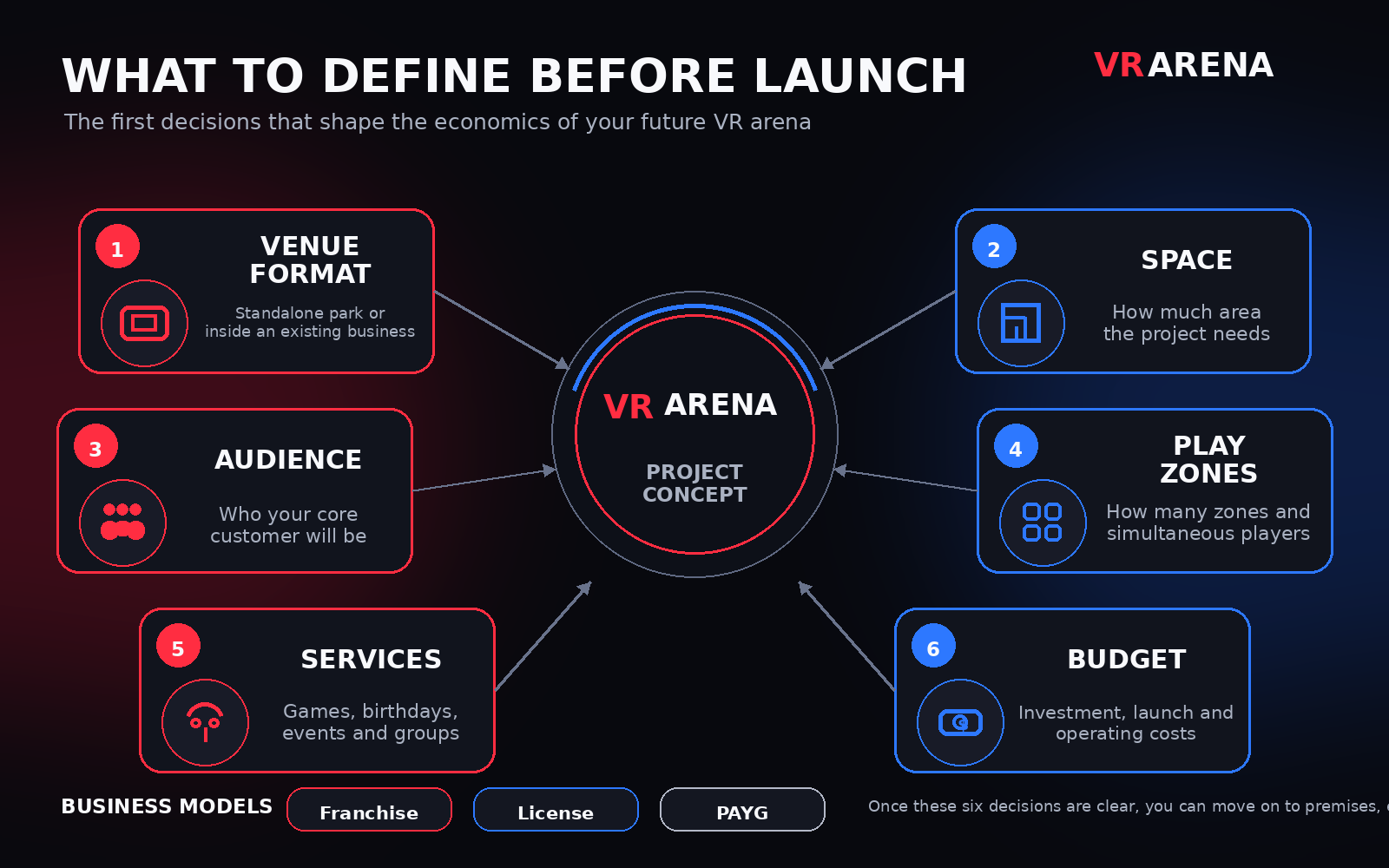
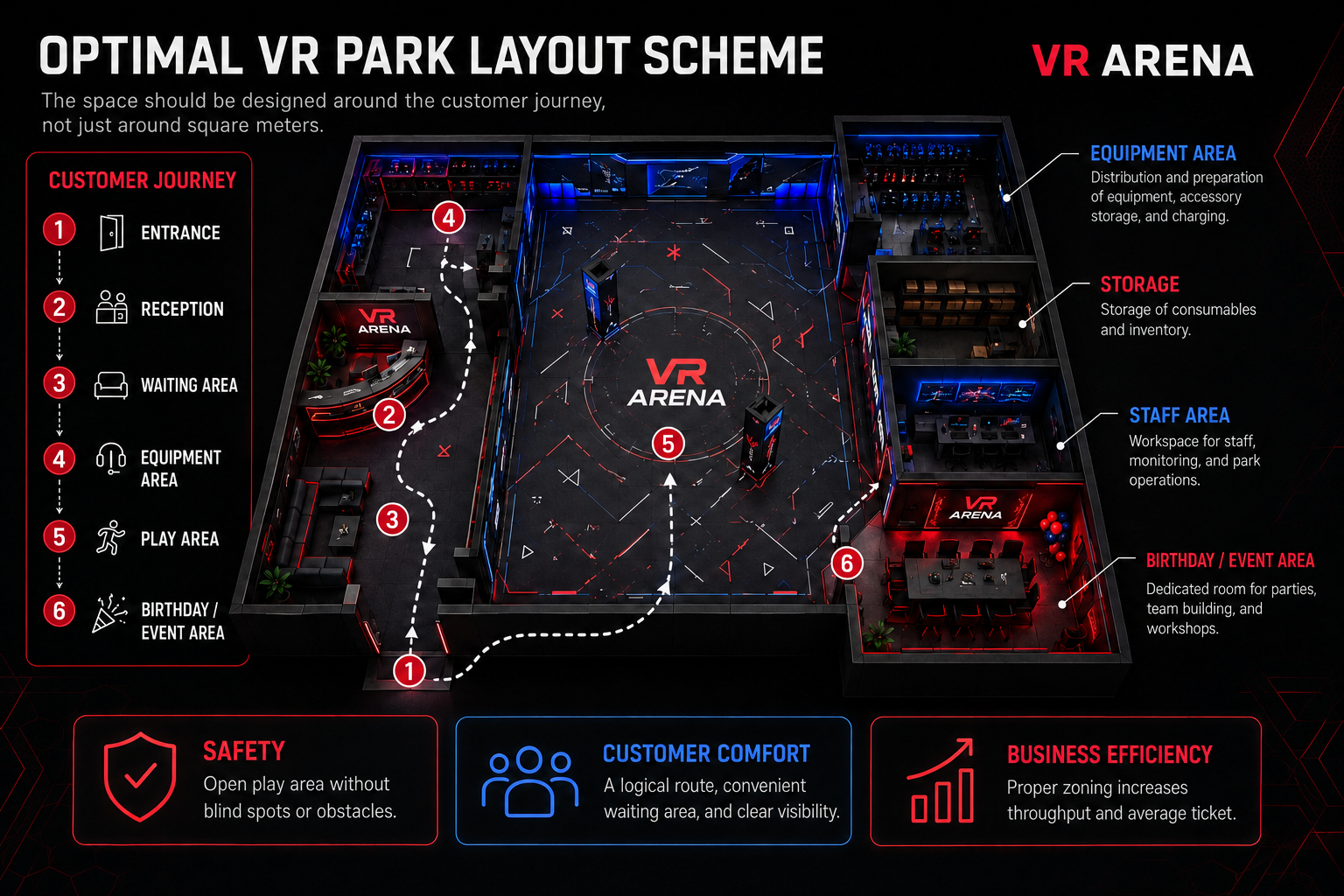
A VR arena can be a compact gaming zone inside an existing entertainment center or a standalone VR park with a reception area, waiting area, and space for birthday parties. The difference between these formats affects almost everything: floor area, investment, amount of equipment, staffing, renovation costs, marketing strategy, and potential utilization.
At this stage, you need to define the venue format, number of gaming zones, core audience, expected average spend, key services, initial budget, and operating model. With VR ARENA, a partner can work under one of three models: Franchise, License, or PAYG. The choice depends on whether the entrepreneur needs a complete business model and launch support or primarily requires software for an existing venue.
Days 2–7. Evaluate the Premises
Work on the premises does not need to wait until the concept is fully completed. These processes can already run in parallel from the second day.
For a fast launch, premises should be evaluated not only by design or rental cost. You need to check the geometry of the play area, space for reception and waiting, equipment storage, electrical capacity, stable internet, ventilation, the possibility of installing partitions, and compliance with local safety requirements.
Free-roam VR differs from a traditional VR club because players physically move through the space. Poor geometry, columns, or unsuitable partitions can therefore seriously limit the usability of the premises.
A technically suitable property can still be a weak business location. At the same time, you should assess the surrounding family audience, schools, residential areas, tourist traffic, visibility, transport access, parking, nearby entertainment, and competitors. A location should not merely allow you to install equipment; it should help the business attract customers.
Days 4–10. Layout and Renovation
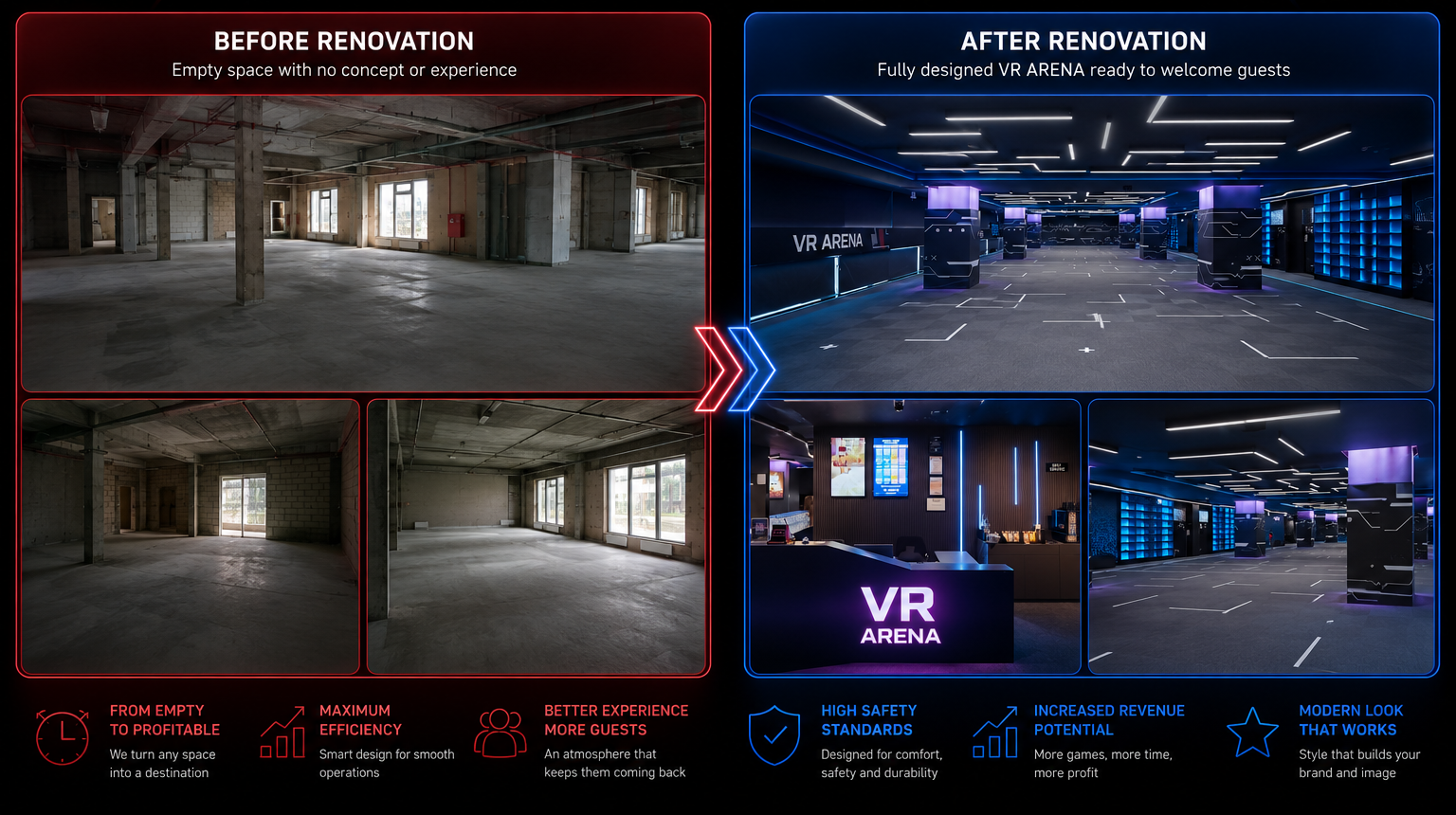
Once the premises have been selected, space preparation begins. For a fast launch, it is especially important not to turn renovation into a design marathon.
The first priority is functionality: a properly configured play area, safe flooring, lighting, electricity, internet, an operator station, reception, equipment storage, and clear guest navigation.
The visual component matters, but it should not block the opening. If complex decorative elements require several additional weeks of production, some of them can be installed after launch. The main principle is simple: first make the premises work well, then continue improving the visual design.
At the same time, technical documentation should never be compromised where safety or correct operation of the space depends on it.
Days 5–12. Order and Prepare the Equipment
One of the most dangerous launch scenarios is to finish the renovation and only then discover that the required equipment is unavailable. Procurement should therefore begin before the construction work is completed.
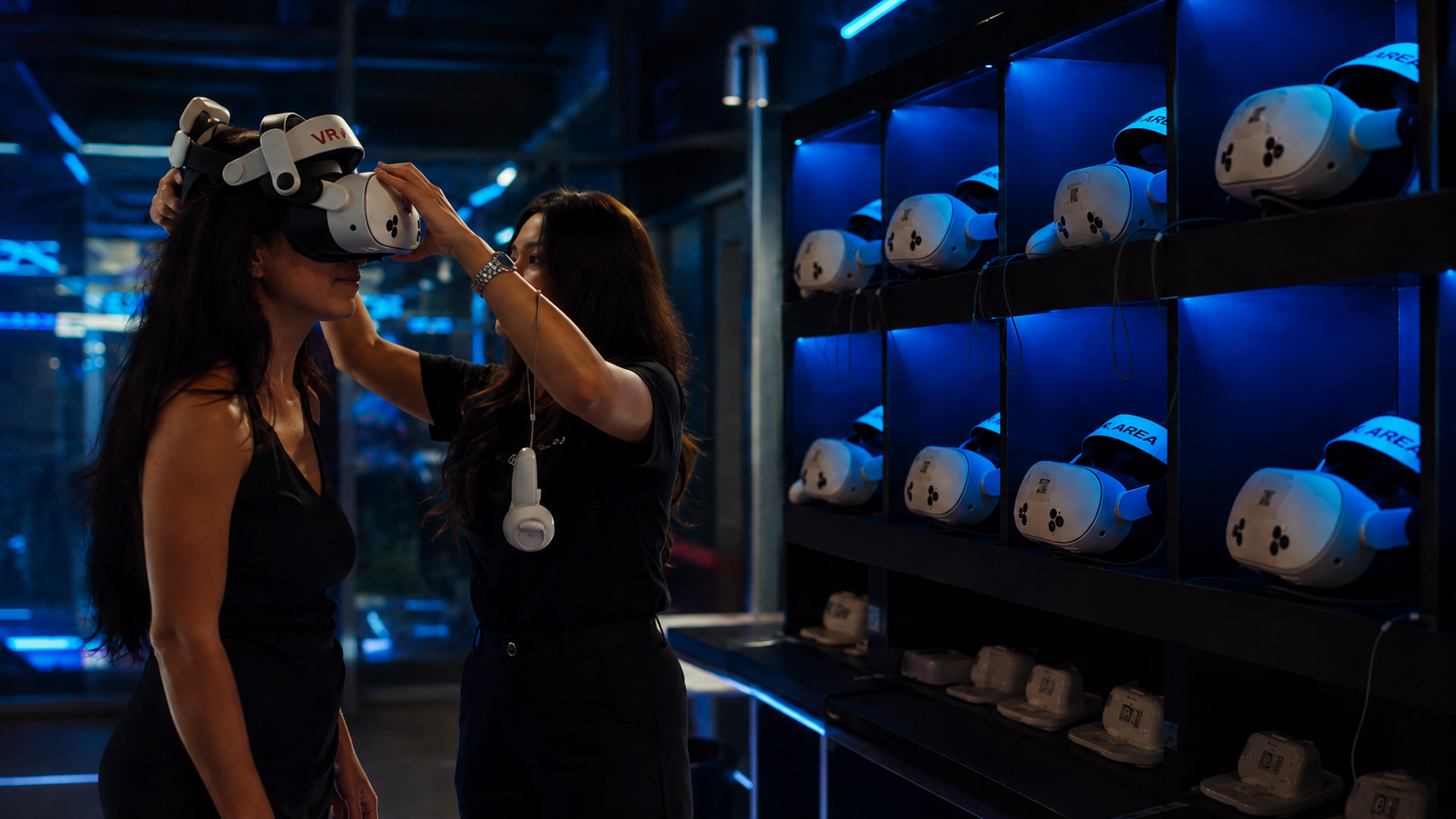
A VR arena requires more than just several headsets. A complete list should be prepared in advance: VR headsets, controllers, chargers, spare batteries, a control device, network equipment, routers or access points, displays, cables, consumables, and replacement components.
It is particularly important to plan for backup equipment. If the venue is designed for a certain number of players, failure of one device should not automatically stop the entire arena from operating.
As devices arrive, they should be powered on, updated, connected to the network, batteries checked, software installed, and several game sessions run. The earlier a technical problem is discovered, the cheaper it is to fix.
Days 7–14. Configure the Software and Test the Games
At this stage, the equipment and premises begin to turn into a functioning VR arena. The system needs to be installed, the play area configured, and the games tested inside the actual venue.
Testing is best done with several people rather than alone. Some VR issues only become visible when multiple participants are playing at the same time.
Check connection stability, play-area configuration, session launch, player connections, controller operation, switching between games, operator actions, match completion, relaunching, and equipment performance across several consecutive sessions.
The main purpose of testing is not simply to confirm that a game launches. You need to test the entire journey: the guest arrives, receives the equipment, enters the game, completes the session, and the equipment is prepared for the next group.
Days 8–15. Build the Product You Will Sell
Opening a VR arena is not enough. You need to decide in advance what exactly the customer will see in the price list.
If visitors are offered only ’60 minutes of VR,’ the business limits itself to a single service. In practice, several products can be created: a standard game session, a visit with friends, a birthday party, a corporate event, a school group, a gift certificate, a tournament, and special offers for off-peak hours.
For each product, define the price, duration, number of participants, package contents, additional services, booking rules, prepayment amount, and cancellation terms.
It is especially important to prepare a birthday-party offer. In VR ARENA’s international experience, group events can become an important source of utilization, so it is better to design these packages before opening rather than after the first ten calls from parents.
Days 10–17. Set Up Sales and Booking
The next task is to make sure a person can not only learn about the new VR arena, but actually book a visit.
At minimum, the system should allow customers to view services, see prices, select a date, contact the venue, make a booking, and receive confirmation. Depending on the business format, this can involve a website, online booking, social media, messaging apps, phone, and CRM.
At launch, it is especially important to determine where a new inquiry goes and who is responsible for answering it. There is little point in spending money on advertising if a customer’s message sits unread for two hours.
Every inquiry should have a source channel, an owner, a status, and a next step. Even a simple CRM with a clear pipeline is more useful at launch than a sophisticated system the team does not know how to use.
Days 12–20. Start Marketing Before Opening
One of the most common mistakes is to start advertising on opening day. The venue is ready, the staff are standing at reception, the equipment is charged, and the business still has to find its customers.
Marketing should start earlier. Even during renovation, you can show the preparation of the premises, arena installation, new equipment, game testing, introductions to the team, the opening date, and the first gameplay footage.
People should hear about the venue before the doors open. By this stage, it is useful to have social media pages, listings on maps and local services, photos, short videos, game descriptions, prices, birthday-party offers, opening information, and a booking form.
You can open bookings for the first dates in advance. This fundamentally changes the launch: on opening day, the business does not face the task of ‘now we need to find customers’ but already has an initial schedule of visits.
Days 15–22. Hire the Team
A small venue does not always require a large team. But even with minimal staffing, roles need to be defined: who greets guests, handles bookings and payments, prepares equipment, launches games, assists players, and monitors the play area.
At a small venue, one employee may perform several functions. At a larger venue, it is better to separate the roles.
Extensive experience specifically in virtual reality is not always essential for a VR operator. More important qualities include communication skills, a calm response to technical issues, responsibility, the ability to learn quickly, and willingness to work with children and groups. The technical side can be taught. Teaching someone to communicate well with guests is usually much harder.
Days 20–25. Train the Team
An employee should personally go through the entire customer journey. It is not enough to show them where the game-launch button is.
They should know how to greet a guest, check the booking, explain the rules, prepare the equipment, help the guest put on a headset, launch the game, solve a basic issue, end the session, prepare the equipment for the next group, and offer a repeat visit.
Unusual situations should also be practiced separately: a device runs out of charge, connection is lost, a player wants to stop early, a child is afraid, one person arrives late, a group wants to extend the session, or a customer is dissatisfied.
It is better to discover weaknesses in the team during a training launch than on a Saturday evening in front of a fully booked group.
Days 23–27. Run Test Sessions
Before the full opening, it is worth running several sessions with real people: friends of the team, employees from neighboring companies, acquaintances, or a small group of invited guests.
However, the test should be conducted as if the team were serving ordinary paying customers. Let participants find the entrance themselves, check in, listen to the briefing, receive the equipment, play, ask questions, and try to book a repeat visit.
After the test, collect feedback. Check whether the venue is easy to find, the navigation is clear, registration is fast enough, the briefing is understandable, the equipment is comfortable, there are delays between groups, staffing is sufficient, waiting is comfortable, payment problems occur, and the booking process works correctly.
This stage often reveals small issues that the team cannot see from the inside.
Days 25–29. Soft Opening
Before a major official opening, it is useful to operate for several days in soft-opening mode. The venue is already accepting customers, but the flow is intentionally limited.
This allows the business to be tested under real operating conditions. During the soft opening, closely monitor group preparation time, schedule delays, technical errors, customer reactions, additional-service sales, staff workload, and feedback.
If a delay keeps appearing between sessions, it is better to discover it with three bookings than with fifteen. At the end of each day, the team should briefly record the issues and fix them before the next shift.
Day 30. Full Launch
By this point, the business should have more than a beautiful sign. The whole system should be working: the customer learns about the VR arena, books a visit, receives confirmation, arrives, plays, pays, leaves feedback, and receives an offer to return.
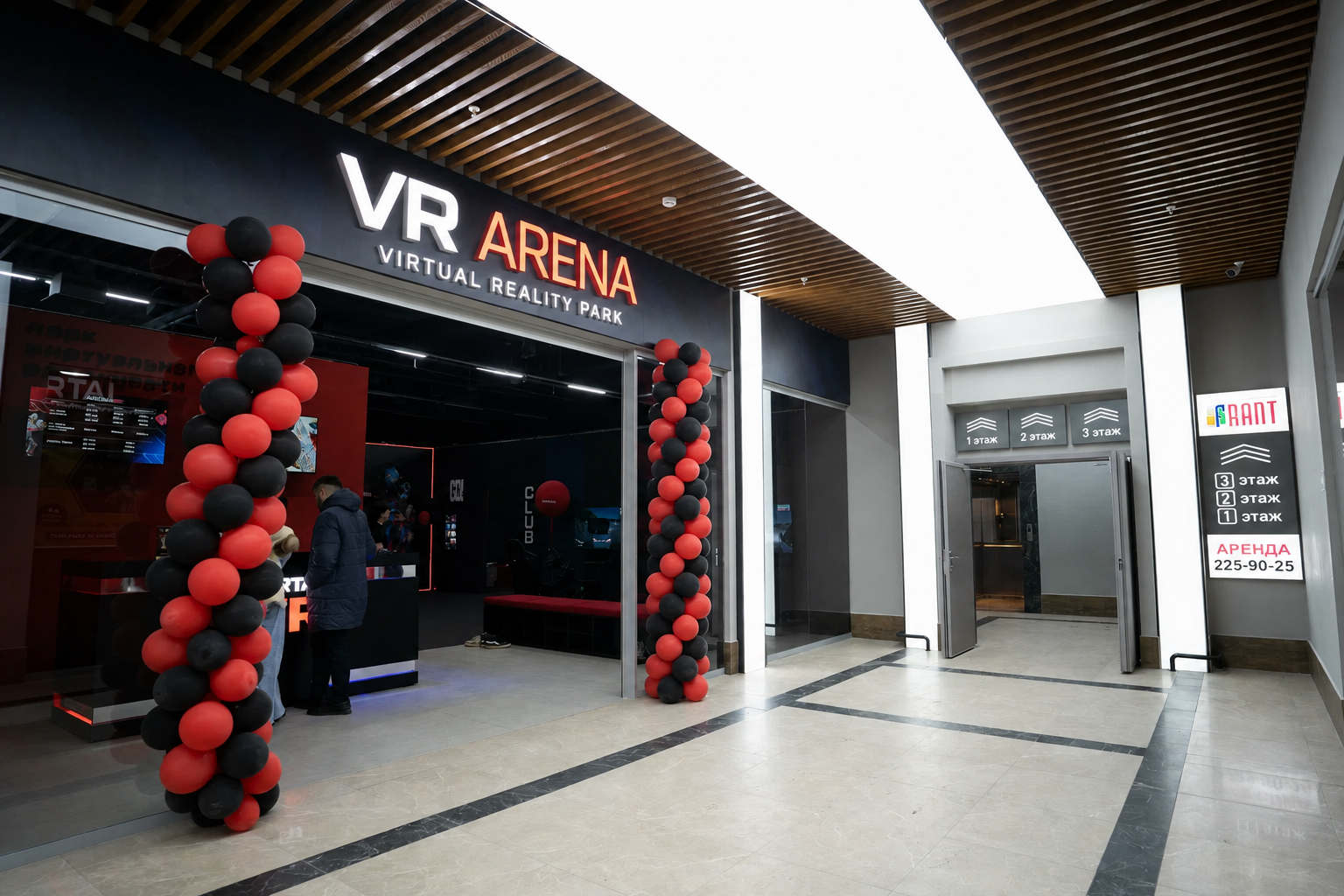
That is what a real launch means. Not installing the final light fixture, not posting a photo with balloons, and not simply opening the door, but completing the first fully functioning customer cycle.
What Must Be Ready Before Opening
Premises
- the play area is ready;
- navigation is installed;
- the internet connection is stable;
- the electrical system is operational;
- the guest area is prepared;
- safety requirements are met.
Equipment
- all devices are configured;
- batteries are charged;
- backup equipment is available;
- the network has been tested;
- multiplayer sessions have been completed.
Sales
- prices have been approved;
- packages are available;
- the booking system works;
- the payment process has been defined;
- employees know how to handle an inquiry.
Marketing
- social media pages are populated;
- map listings and the address are up to date;
- photos have been uploaded;
- the opening date has been published;
- the first advertising materials are ready.
Team
- employees have completed training;
- they know the games;
- they can solve basic technical problems;
- they understand the service standards;
- they know what to do in unusual situations.
The Main Mistake: Trying to Finish Everything Before the First Customer Arrives
Entrepreneurs naturally want to open a perfect venue: finish the entire design, shoot professional videos, complete the website, configure the perfect CRM, write dozens of instructions, and prepare a huge marketing campaign.
But some of these processes can be improved after launch. Before opening, you need to complete what directly affects safety, gameplay, service, payment, booking, and the quality of the customer experience.
Everything else can be developed gradually. A fast launch is therefore not based on the principle of ‘finish absolutely everything in one month,’ but on another principle: build a functioning system in one month that can serve its first customer well.
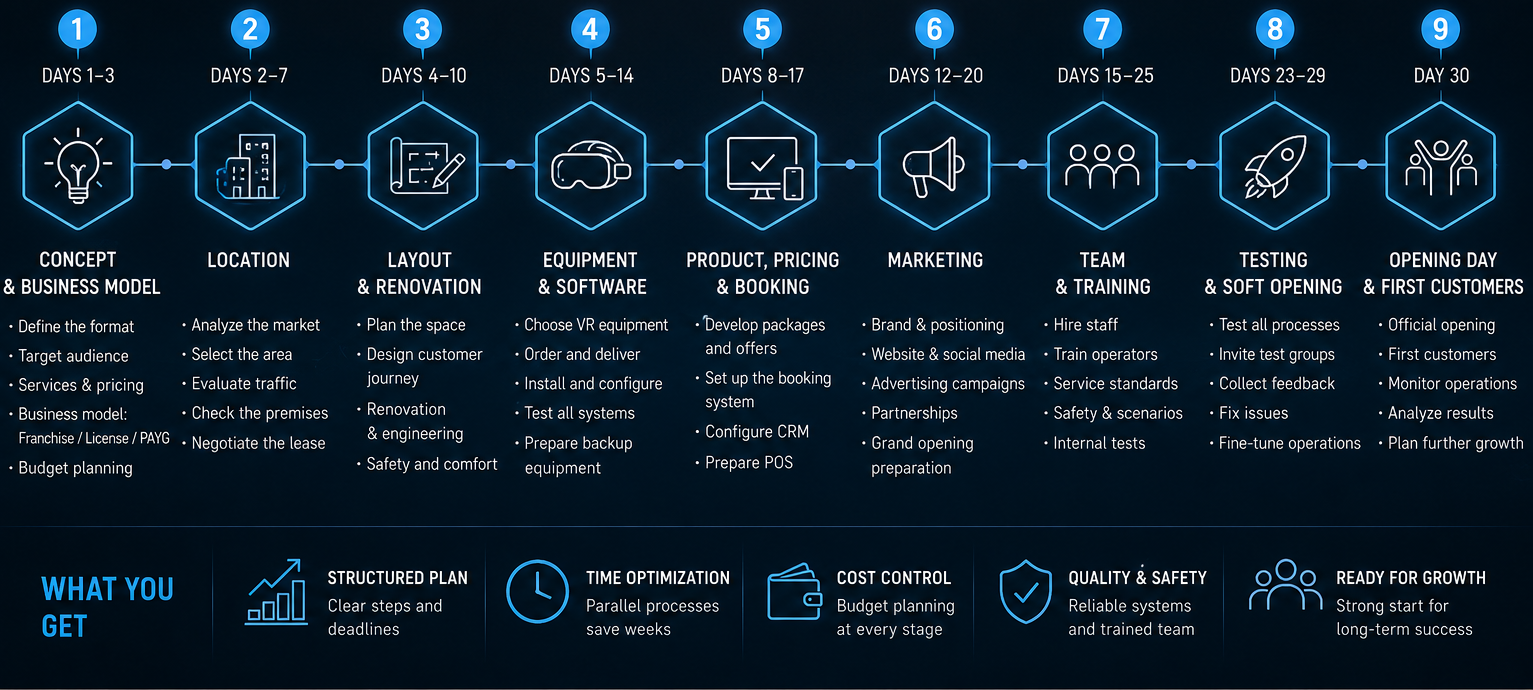
30-Day VR Arena Launch Calendar
- Days 1–3: concept, format, budget, and operating model.
- Days 2–7: final selection and technical evaluation of the premises.
- Days 4–10: layout and venue preparation.
- Days 5–12: procurement and initial equipment setup.
- Days 7–14: software installation and testing.
- Days 8–15: development of services, packages, and pricing.
- Days 10–17: booking, CRM, and inquiry-handling process.
- Days 12–20: launch of social media and pre-opening marketing.
- Days 15–22: team recruitment.
- Days 20–25: staff training.
- Days 23–27: test game sessions.
- Days 25–29: soft opening.
- Day 30: full commercial launch.
Most stages overlap. It is this parallel work that makes a 30-day scenario possible.
What Happens After Opening
Day 30 is not the end of the project. The first weeks provide the most valuable information about the real business.
You need to track where customers come from, which games they choose, which packages sell best, how many people return, which hours remain underused, how long it takes to serve a group, which questions are asked most often, where technical issues occur, and which advertising channels generate bookings.
Based on this data, the business adjusts advertising, prices, schedules, staffing levels, scripts, package offers, and operating instructions. Launching a VR arena is not the moment when the business becomes finished. It is the point when real data begins to appear.
Key Takeaway
Opening a VR arena in 30 days is possible not because renovation is carried out faster or employees work around the clock. Speed comes from the correct sequence and coordination of processes.
While contractors prepare the premises, equipment is being configured. While the equipment is being tested, marketing is being launched. While advertising collects the first inquiries, the team is being trained. While employees practice, advance booking is opened.
This is how several months of sequential work can become several weeks of parallel execution.
VR ARENA’s international experience shows that an entrepreneur does not need to invent every element of the project independently, from play-area configuration to the operating model. A ready technological foundation, instructions, marketing materials, training, and technical support allow the team to focus on the most important task: preparing the venue and bringing in the first customers.
The real result of the first month is not measured by whether the final decorative detail was completed. It is much simpler: the first customer arrived, played, was satisfied, and wanted to come back.

