

Franchise or Subscription: Which Model to Choose for Opening a VR Arena
Franchise or Subscription: Which Model to Choose for Opening a VR Arena
There are several ways to open a VR arena today. You can buy the equipment yourself, select the games, and assemble the entire system. You can subscribe to ready-made gaming content. Or you can use a franchise and get a ready-to-launch business model along with the technology.
Which option is better? There is no universal answer.
The choice depends primarily on what the entrepreneur already has at the start: experience in offline business, an existing location and audience, their own brand, knowledge of VR, and technical expertise.
That is why a franchise and a subscription are not so much two pricing plans for the same product as solutions for different needs.
Subscription: when VR content is what you need first and foremost
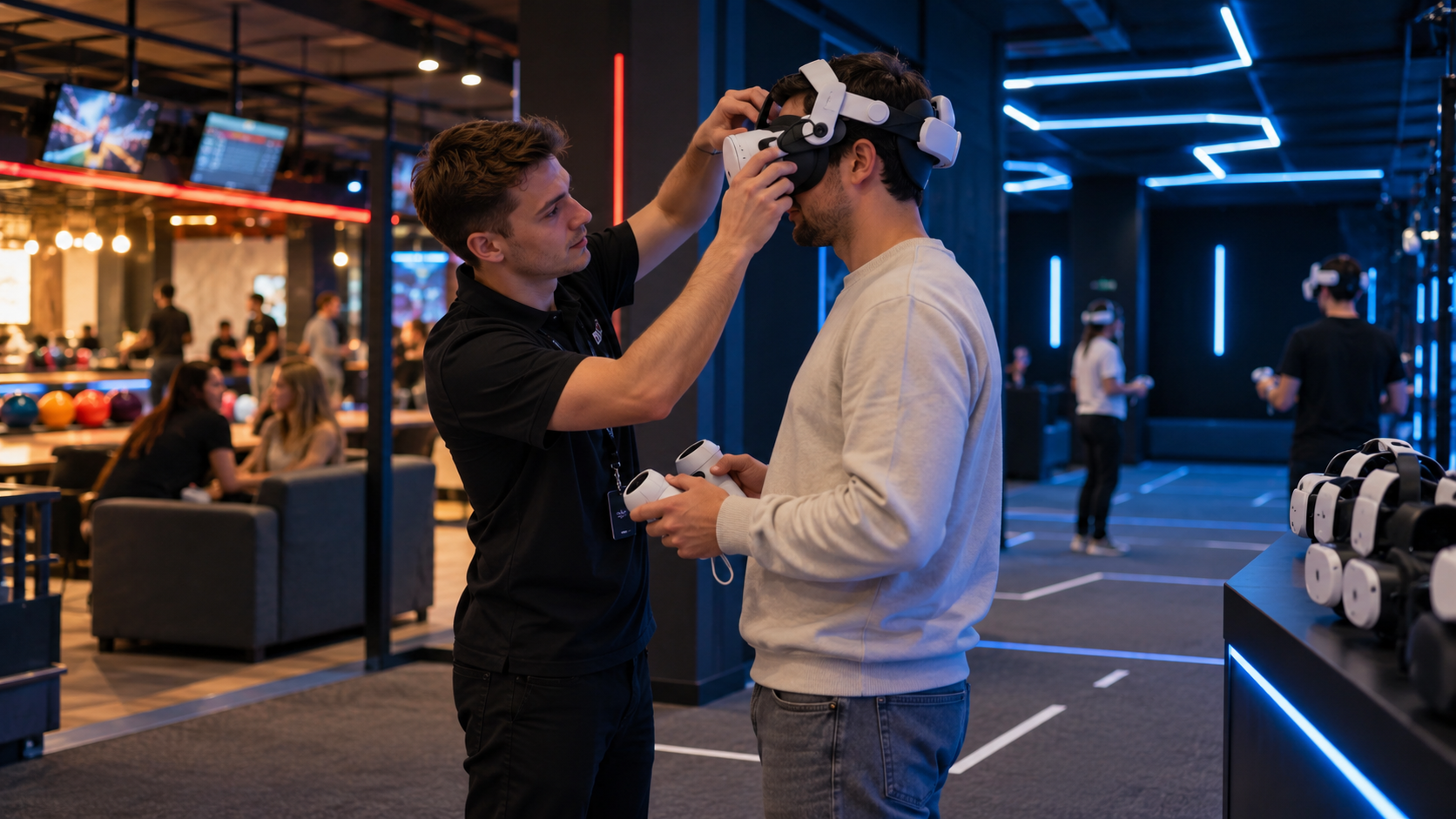
If an entrepreneur already has an operating entertainment business, there is usually no need to teach them again how to attract customers, manage staff, or work with a venue.
For example, a VR zone can become an additional product for:
- a family entertainment center;
- a bowling center;
- a go-karting venue;
- a trampoline park;
- a restaurant that hosts birthday parties;
- an event and workshop space;
- an existing VR club.
In this case, a subscription is the most logical option.
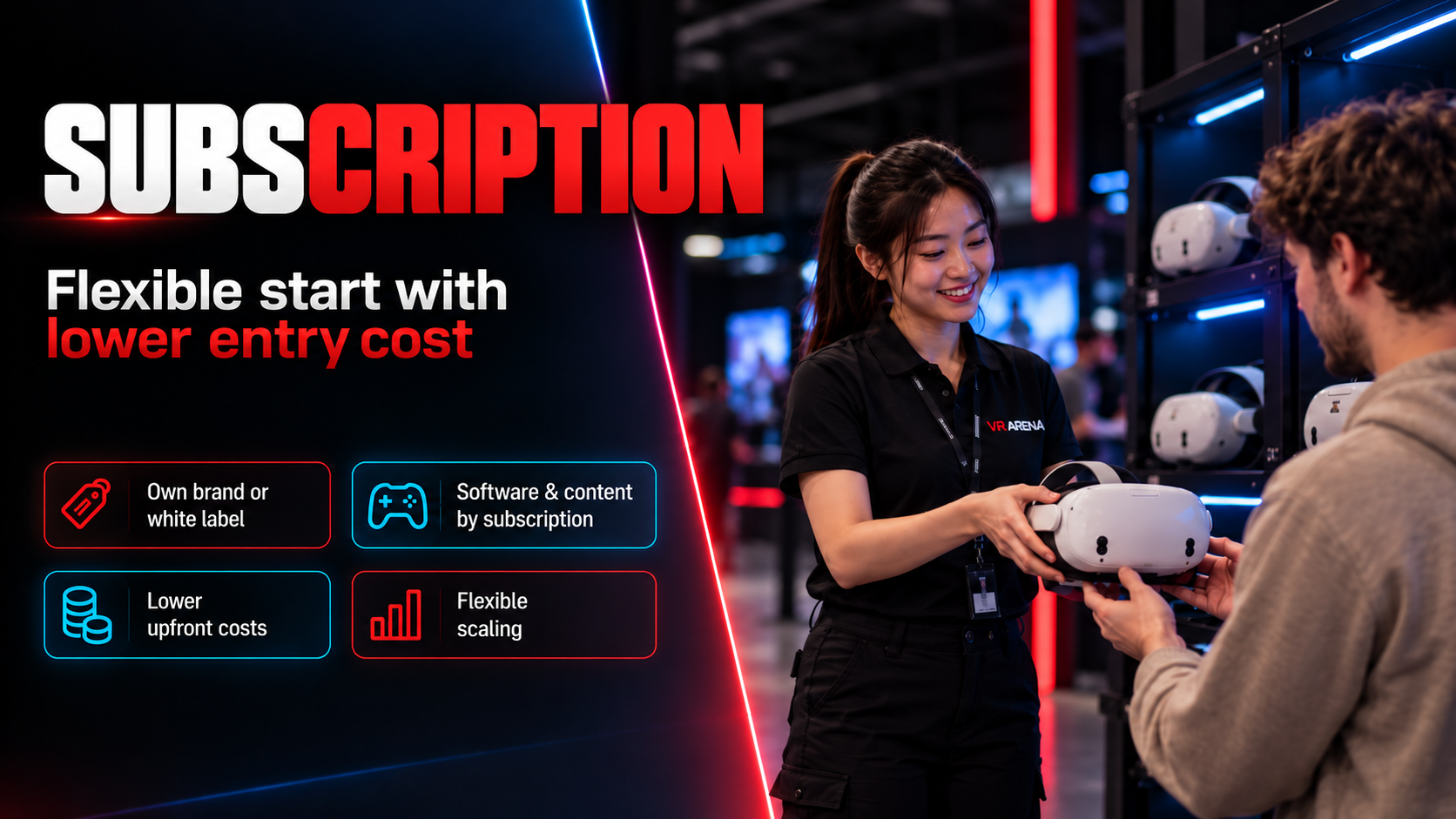
The entrepreneur receives VR ARENA gaming content, the software platform, instructions, a website template, and marketing materials, while independently handling most issues related to creating and developing the business.
Integrating VR into an existing location does not necessarily have to turn into a large-scale project. In our experience, such a zone can be launched in approximately two weeks from the first conversation.
The equipment is widely available on the open market almost anywhere in the world, software installation is highly automated, and during the launch stage the partner is supported with instructions, technical support, and an engineer.
Subscription pricing starts at approximately $4,000, excluding equipment, premises, and other location-specific expenses.
A franchise solves a different problem
Consider another situation.
An entrepreneur has a venue or an investment budget and wants to open a new entertainment business, but has never operated a VR arena before.
In this case, the problem is no longer simply where to get the games.
They need to determine whether the premises are suitable, build a financial model, define the number of gaming zones and their capacity, choose equipment, design the space properly, create branded interiors, a website and booking system, and prepare marketing for the opening.
At this point, the number of small decisions quickly becomes very large.
That is why a franchise is better viewed as packaged experience in launching a VR business and a way to buy time, rather than simply an expanded game license.
The VR ARENA PREMIUM package starts at a one-time fee of $10,000 on top of the license cost and includes project support from initial planning through launch.
It includes financial modeling, assistance with venue selection and layout, custom location design, furniture and equipment budgeting, a launch guide, pricing and promotional package recommendations, technical assistance, and access to the knowledge base.
The entrepreneur also receives a ready-made set of marketing materials, from SMM and web content to game posters, videos, printed materials, and merchandise, as well as a prepared website with an online booking system.
In other words, the entrepreneur is not paying simply for a brand. They are paying to avoid assembling dozens of essential elements of a new business separately and learning from every mistake on their own.
Where people most often make mistakes when opening a VR arena

Interestingly, the main risks are far from limited to the VR technology itself.
Over the past several years, we have participated in hundreds of launches and repeatedly seen the same problem: an entrepreneur can spend an enormous amount of effort finding a venue, renovating it, purchasing equipment, and handling the technical launch, only to discover after opening that the hardest part is just beginning.
The main task of an entertainment business is to maintain consistent venue utilization.
To do this, you first need to attract people and then make sure they return and recommend the venue to others.
One of the most common mistakes is cutting back on launch marketing. If too few people know that a new entertainment option has opened, it is unrealistic to expect them to somehow discover it on their own afterward.
The second mistake is underestimating group events.
Birthday parties and corporate events are especially important to the economics of a VR arena. One such customer immediately brings an entire group of potential future customers. If the event goes well, each participant may return later with their own family, friends, or colleagues.
That is why the quality of every event directly affects the location’s future utilization.
There are also less obvious mistakes at the start: choosing the wrong equipment or accessories, an inefficient venue configuration, poor zoning, or insufficient capacity.
A franchise does not eliminate entrepreneurial risk, but it can help you avoid repeating mistakes that others have already made before you.
A franchise can be cheaper than launching independently
At first glance, it seems simple: a subscription costs less, so launching with a subscription should be more cost-effective.
For an existing business, that is often true.
If you already have a venue, brand, website, staff, marketing, and customer traffic, there is little sense in paying again for what has already been created.
But the economics look different when launching a new standalone VR location.
You will still need to commission a design project. A website will still have to be built. You will need photos, videos, advertising layouts, printed materials, a booking system, a financial model, and many other elements.
If all these services are purchased separately, the entrepreneur spends not only money but also their own time finding contractors, assigning tasks, and monitoring the results.
Therefore, all else being equal, a ready-made package can reduce both initial costs and the time required to prepare the project. A faster launch also means revenue can start sooner and the investment may potentially be recouped faster.
At the same time, it is incorrect to compare the payback of a franchise and a subscription directly. Adding a VR zone to an existing entertainment center and building a standalone business from scratch require completely different levels of investment.
Franchise or Subscription: Comparison
| Criterion | Subscription | Franchise |
| Primary goal | Add VR content to an existing business | Launch a full-scale VR business |
| Cost | from $4,000 for the subscription | subscription + one-time fee from $10,000 for the launch package |
| Gaming content | Yes | Yes |
| Instructions and basic materials | Yes | Yes |
| Website template | Yes | Full website and booking system setup |
| Marketing materials | Basic set | Expanded ready-to-use package |
| Venue analysis | Independent | Together with the team |
| Layout and zoning | Independent | Included in the support package |
| Design project | Independent | Included |
| Financial modeling | Independent | Included |
| Equipment selection and budgeting | Independent | Team assistance |
| Experience from other VR locations | Limited | Transferred as part of the launch model |
| Post-launch support | Technical support | Technical support + dedicated account manager + knowledge base |
| Brand | You can develop your own | Ready-made VR ARENA concept |
| Best suited for | Existing entertainment business, own brand, existing VR club | New standalone VR business, especially without prior industry experience |
When you probably do not need a franchise
We do not recommend a franchise to every partner.
For example, if you already operate a successful FEC, bowling center, or trampoline park, have your own marketing and a steady audience, and need VR simply as another product within the existing business, a subscription is often enough.
The same applies to an entrepreneur who wants to develop their own established brand and clearly understands that what they primarily need from VR ARENA is the games and technology.
A franchise may also be excessive for smaller venues, for example those under 100 m², where there is one gaming zone without a separate lounge and the location relies mainly on shopping mall traffic or small groups.
Why pay for a solution to a problem you do not have?
When a subscription alone may not be enough
The opposite situation is more common.
An entrepreneur wants to minimize initial costs and purchase only the gaming content, but during the conversation it becomes clear that they are opening an entertainment venue for the first time, have never worked with VR, have not yet chosen the premises, and do not have a ready model for attracting group customers.
This does not mean that they must necessarily be sold a franchise.
Our task is to identify the project’s weak points and maximize its chances of success regardless of the chosen cooperation model.
Ultimately, the logic here is simple and win-win: if our partners make money, we make money too.
A franchise does not guarantee success
This is perhaps the most important thing to understand before purchasing any franchise.
A franchise does not turn a business into passive income.
It can save time, let you use accumulated experience, avoid some mistakes, and therefore reduce risks. But responsibility for the result remains with the business owner.
You still need to do marketing. You need to sell events. You need to work with the team. You need to monitor service quality, talk to customers, and collect feedback.
If you want completely passive income, that is what a bank deposit is for.
A franchise is a tool for an entrepreneur, not a replacement for one.
So, which should you choose?
There is a fairly simple way to determine which model is closer to your needs.
Ask yourself:
“How confident am I that I understand all the nuances of VR both as a technology and as a business in which a significant share of revenue comes from birthday parties, corporate events, and other events for large groups?”
If you already have an operating entertainment venue, an audience, a team, marketing, and your own brand, and your goal is to add a high-quality VR product, then a subscription is most likely what you need.
If, on the other hand, you are creating a new VR location from scratch and want to move more quickly from finding a venue to operating a business by using the experience of already launched projects, then a franchise is worth considering.
The key is to choose not the option that looks cheaper on the price list, but the one that solves your specific problem.

