

How to Minimize VR Equipment Downtime: Practical Solutions
For a VR park owner, equipment downtime is usually associated with technical problems: a headset runs out of charge, the connection drops, or a device has to be sent for repair.
But there is another type of downtime in the VR business, and it can cost significantly more.
The equipment is fully operational. Staff are on site. Rent is being paid. Electricity, internet, and other fixed costs continue to accrue. But the play area is empty.
This happens especially often in the morning and during the first half of weekdays, when the core audience is at school, university, or work.
That is why the task of a VR park manager is not only to attract more visitors overall. The business needs to learn how to redistribute demand and create dedicated products for the hours that ordinary retail customers tend to leave underused.
In VR ARENA’s international practice, one of the most effective approaches is to develop several sales channels at the same time: schools, universities, corporate clients, events, third-party organizations, and partnership programs.
This allows the equipment to work not only in the evenings and on weekends.
Start by Calculating When the Equipment Is Actually Idle
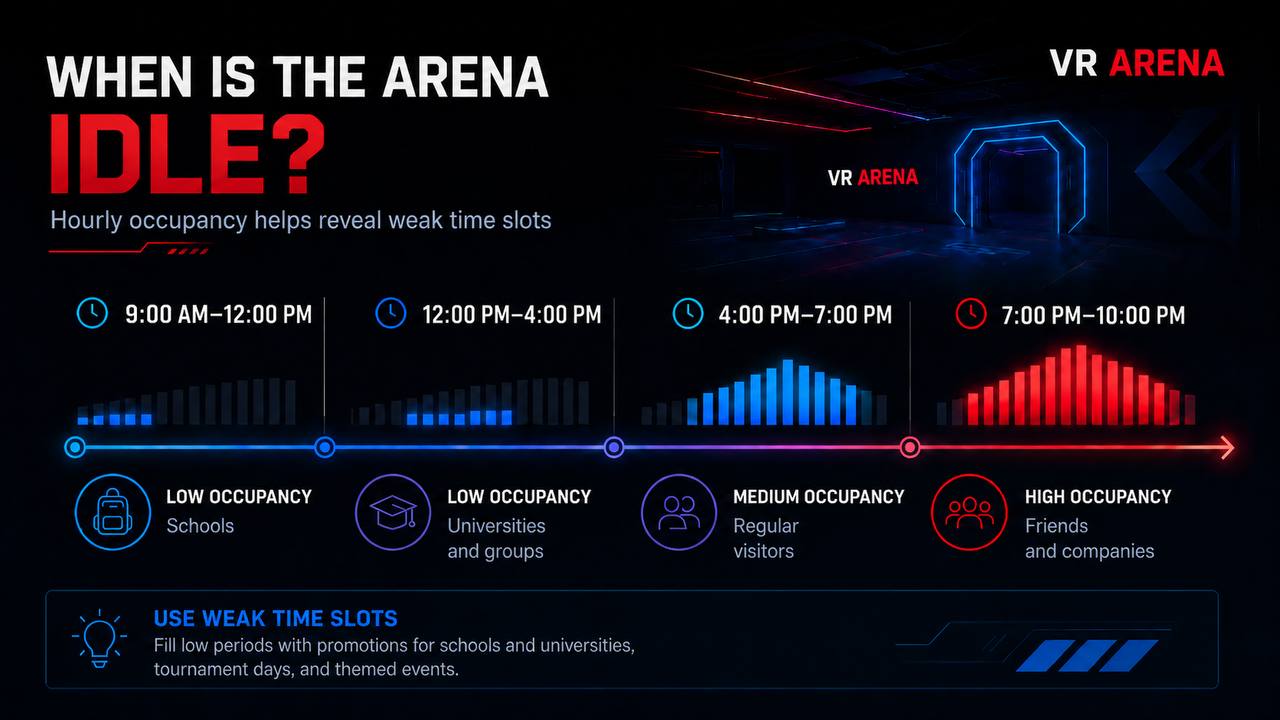
Before launching new advertising or offering discounts, you need to see the real utilization picture.
- how many play zones were available;
- how many of them were actually used;
- how many sessions took place;
- how much revenue was generated;
- what type of customer occupied each slot;
- how much available time remained unused.
For example, a venue may be fully booked on Friday evening and Saturday, while operating at only 10–20% of capacity on Tuesday through Thursday mornings.
Average monthly utilization may still look acceptable and hide the underlying problem.
That is why you should analyze not only monthly revenue, but also utilization by day of the week and hour.
Once you do this, idle time stops being an abstract problem. Specific windows become visible: Monday to Friday, 9:00 a.m.–12:00 p.m.; weekdays, 12:00–4:00 p.m.; selected evening hours; and seasonal periods of lower attendance.
And each of these time windows can be matched with a different audience.
Schools: One of the Best Ways to Fill Morning Hours
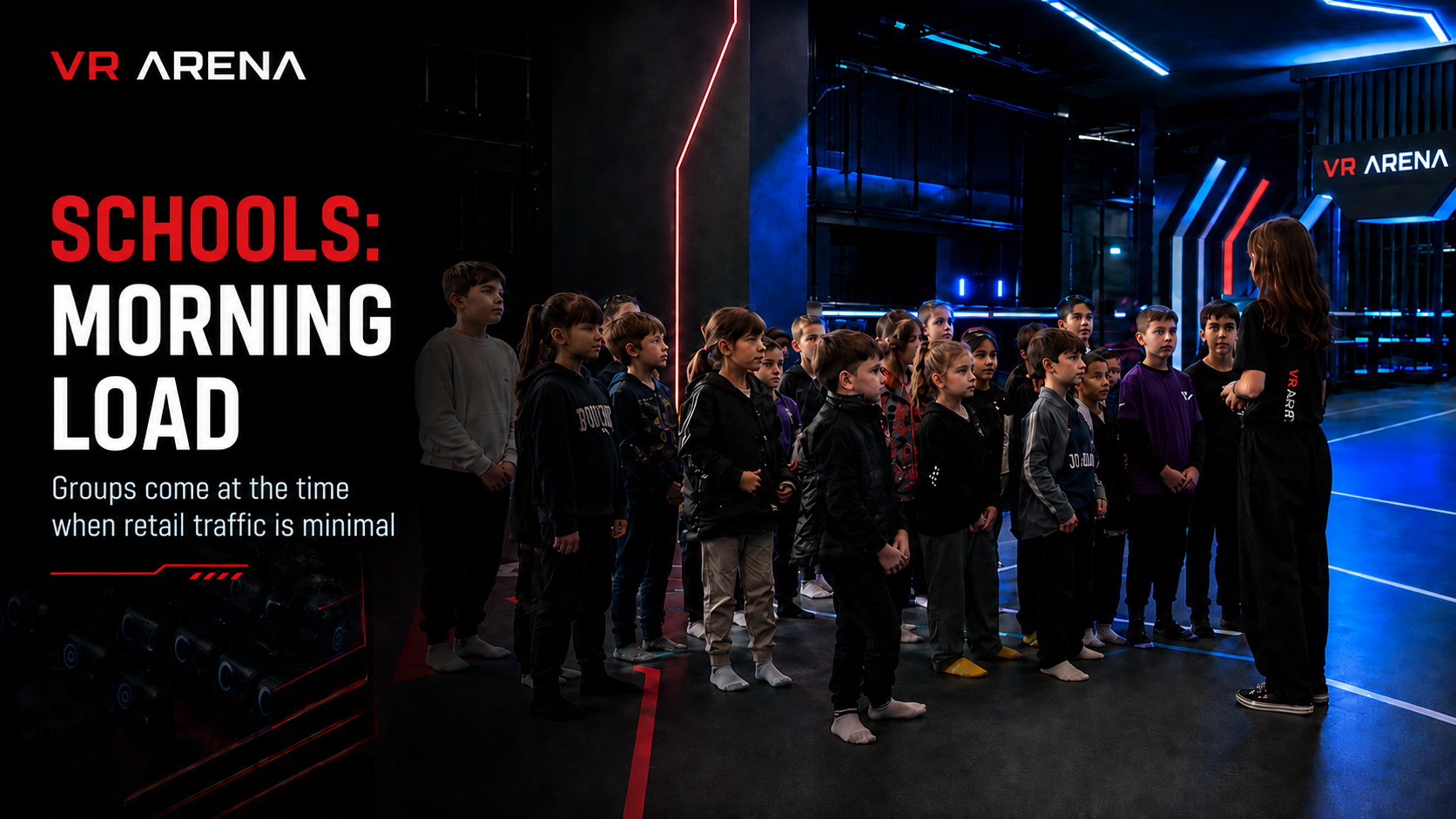
An ordinary retail customer rarely comes to play VR at 10 a.m. on a weekday. A school group, on the other hand, may plan an off-site activity at exactly that time.
That is why schools can complement the standard VR park business model very well.
In VR ARENA’s Turkish practice, working with schools has been developed as a separate direction. The team proactively contacts both private and public educational institutions and maintains relationships with several dozen schools.
The schedule itself is particularly important. Most of these activities take place from the morning until lunchtime. In other words, school groups fill the very hours that might otherwise remain almost empty without group sales.
One large school can bring several groups one after another and occupy a significant share of the weekly schedule.
What Should You Sell to a School?
It is inconvenient for a school to buy ‘six VR headsets for one hour.’ What it needs is a ready-made group product.
For example, a ‘VR Day for a Class’ package may include:
- a defined number of participants;
- several game sessions;
- dividing the class into teams;
- support from an operator;
- a predefined duration;
- one fixed price for the group.
You can create several versions for different class sizes. It is important that a teacher or organizer does not have to assemble the program from separate services.
The simpler the offer, the easier it is for the school to approve the visit.
Do Not Wait for Schools to Contact You — Reach Out Proactively
Working with educational organizations is different from ordinary advertising. A teacher or school principal is unlikely to see a VR park banner and spontaneously decide to bring several classes.
That is why a proactive B2B approach is needed.
Your prospect database can include:
- private schools;
- public schools;
- international schools;
- language schools;
- educational centers;
- summer camps;
- children’s clubs.
Next, identify the people who make the decision:
- principal;
- deputy principal;
- extracurricular activities coordinator;
- class teacher;
- education program manager;
- parent committee representative.
The first contact does not have to result in an immediate sale. The goal is to introduce the organization to the format and create an opportunity to discuss a group event.
For this, it is useful to have a separate short presentation of several pages:
- What the VR park is.
- What age groups the format is suitable for.
- How many people the venue can accommodate.
- How the visit works.
- How long the program takes.
- What group package options are available.
- How booking works.
After the first successful visit, a school stops being a one-time customer. A long-term relationship can be built with it.
Universities and Colleges Can Fill the Next Part of the Day
If schools are especially suitable for morning hours, university audiences may be attractive during the day and on weekday evenings.
The offer for universities should look different. Students do not necessarily need to be sold a standard visit package.
You can create dedicated formats such as:
- interfaculty VR tournaments;
- student championships;
- freshman events;
- student club meetups;
- gaming nights;
- competitions between universities;
- events for student organizations.
This turns the VR venue into not just a place for individual play, but infrastructure for a complete event.
Outreach can be built through student councils, university clubs, student affairs departments, event organizers, sports clubs, and esports communities.
As a separate channel for filling underused hours, the university audience deserves systematic development.
Corporate Events: Equipment Can Be Busy for Weeks, Not Just One Hour
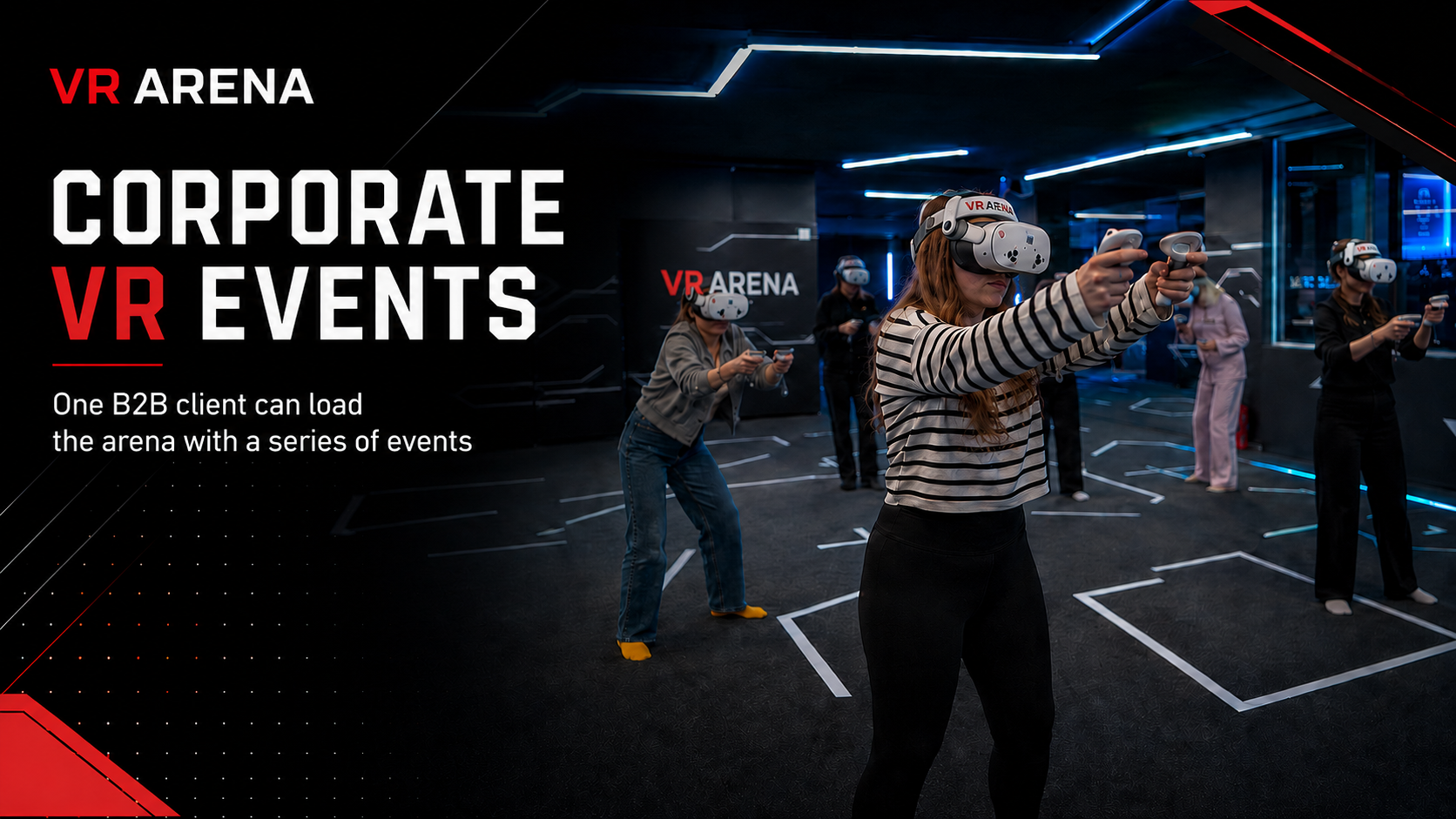
Another way to increase utilization is to develop the corporate segment.
Companies buy a completely different product. They do not simply come to ‘play VR.’ Their objective may be to:
- hold a team-building event;
- organize a corporate tournament;
- celebrate a company milestone;
- run an entertainment program for employees;
- organize a competition between departments;
- hold a branded activation.
This makes it possible to sell larger events and reserve significant blocks of the schedule in advance.
VR ARENA’s Turkish experience includes a strong example: a corporate tournament for Fraport. Around 200 people took part. The tournament ran for approximately one month, with teams playing through multiple stages, followed by semifinals and finals.
For a VR park, this represents a completely different level of utilization planning. Instead of dozens of individual customers, one contract can create a regular flow of sessions over several weeks.
But these sales take time. Negotiations for a large corporate project can last for months. That is why relying only on incoming corporate requests is risky. You need to build a proactive B2B pipeline.
Who Should Handle Corporate Sales?
A regular call-center operator is well suited to a request such as, ‘How much does a birthday party for 10 people cost on Saturday?’ A corporate sale looks very different.
It requires you to:
- find the company;
- reach the decision-maker;
- understand the objective;
- prepare a proposal;
- hold several calls;
- agree on the program;
- adjust the terms;
- wait for internal approval;
- agree on dates;
- organize the event.
That is why the B2B direction is better managed separately.
You can work with HR departments, event managers, internal communications teams, marketing departments, office managers, and company executives.
For large clients, it is better to prepare a dedicated commercial proposal rather than send the standard VR park price list.
Partner with Event Agencies
You do not need to find every event on your own. There are already companies whose job is to constantly look for venues and activities for their clients.
These include:
- event agencies;
- corporate event organizers;
- birthday party agencies;
- team-building agencies;
- conference organizers;
- promotional agencies;
- marketing agencies.
For them, a VR park can become a ready-made product in their catalog. This is especially valuable because one agency can potentially bring several different companies.
Instead of starting the sales process from zero every time, the venue creates a partnership channel.
For an agency, you can prepare:
- dedicated partner terms;
- capacity information;
- photos;
- videos;
- ready-made event scenarios;
- group pricing;
- contact details for a dedicated manager;
- a quick way to check available dates.
The biggest mistake is to give an agency the general phone number and tell them to ‘check the website.’ A partner needs a simple way to quickly obtain an offer for their own client.
Work with Businesses That Already Have Your Audience
A strong partnership model does not necessarily mean a direct sale. Sometimes it is more effective to connect with an organization that already works with the audience you need.
For example:
- entertainment centers;
- bowling venues;
- go-kart centers;
- restaurants;
- family entertainment centers;
- party organizers.
In Italy, VR ARENA is growing through the integration of arenas into existing entertainment venues. This allows operators to use an existing customer flow instead of building it entirely from scratch.
The same logic applies to marketing partnerships. A restaurant can recommend a VR park to customers as the next part of a birthday celebration. A VR park can recommend a restaurant after the game program. A party organizer can include VR in a package.
Several businesses begin sharing access to the same audience.
Turn the Event into a Product, Not a Custom Project
If the team designs every corporate event from scratch, the sales department quickly turns into a small architecture studio for building other people’s fantasies.
For scalability, it is better to have several standardized scenarios.
Team Building
- a group of up to a defined number of participants;
- division into teams;
- a tournament;
- several game rounds;
- a final;
- results and wrap-up.
Corporate Tournament
- qualification rounds;
- tournament bracket;
- semifinals;
- final;
Brand Event
- branding of selected elements;
- game program;
- spectator screen;
- photo or video content;
- competition between participants.
VR ARENA already has experience designing VR formats for branded events and tournaments, where gameplay is supported by spectator screens, match results, content, and other event mechanics.
The more elements are standardized, the faster a manager can prepare a proposal.
Do Not Price Off-Peak Hours Like Prime Time
One common mistake is managing the entire schedule in the same way. Saturday at 6:00 p.m. and Tuesday at 10:00 a.m. have completely different commercial value.
The goal is not to lower the price when customers are already willing to buy. It is better to create dedicated products specifically for weaker periods.
For example:
- School Morning – a special group format for weekday mornings.
- Student Day – tournament or group programs during selected weekday hours.
- Corporate Weekdays – dedicated terms for companies holding events during off-peak periods.
This does not have to be a standard discount. You can add value instead: more game time, an extra round, a separate tournament, photos, an additional play zone, or a special package for a larger group.
This gives customers a reason to choose an off-peak slot without undermining the core price.
Create a Separate B2B Utilization Calendar
Retail bookings usually operate on a horizon of a few days or weeks. B2B can be planned much further in advance.
Schools may schedule trips in advance. Companies plan major events weeks or months ahead. Event agencies work with future dates.
That is why it is useful to maintain a separate B2B calendar. It should show:
- potential events;
- tentatively agreed dates;
- confirmed events;
- number of participants;
- number of play zones required;
- responsible manager;
- deal probability.
This makes it possible to identify weak periods in the following month in advance and direct the sales team’s efforts toward them.
Track Not Only Revenue, but Also Equipment Utilization
To evaluate whether the strategy is working, we recommend tracking several indicators:
Equipment Utilization
What percentage of available gaming hours is actually used.
Revenue per Available Gaming Hour
How much revenue one hour of potential arena operation generates.
Off-Peak Utilization
A separate indicator for time slots that have historically remained empty.
Share of Group Events
What portion of the schedule is generated by schools, companies, universities, and other organizations.
Repeat B2B Bookings
Whether organizations return after their first event.
Average Group Size
How many participants one group customer brings.
This makes it clear whether new partnerships are actually reducing idle time or simply creating more activity for the sales team.
Technical Downtime Also Needs to Be Planned
Commercial utilization does not mean that equipment should operate nonstop around the clock. Quite the opposite. The higher the utilization, the more important it becomes to plan maintenance in advance.
It is useful to:
- keep backup devices;
- monitor batteries;
- check the network regularly;
- update equipment outside prime time;
- carry out preventive maintenance during periods of lowest demand;
- plan replacement of consumable components in advance.
If Monday morning has historically been a weak period, part of the technical maintenance can be scheduled for that time.
This turns technical downtime into planned downtime and reduces its impact on sales.
Practical Plan for Reducing Downtime
- Export hourly venue utilization data for the last several months.
- Identify recurring weak time windows.
- Match each window with a potential audience: mornings — schools; daytime — universities, camps, and organized groups; weekdays — corporate clients and event agencies.
- Create a dedicated package for each segment.
- Prepare a B2B presentation and materials for partners.
- Build a database of organizations and begin proactive outreach.
- Maintain a separate B2B pipeline and calendar of future events.
- After several months, compare off-peak utilization before and after launching the program.
Key Takeaway
There are two main ways to increase the efficiency of a VR park.
The first is to keep buying more advertising and try to attract more individual customers.
The second is to make the equipment work for several different markets.
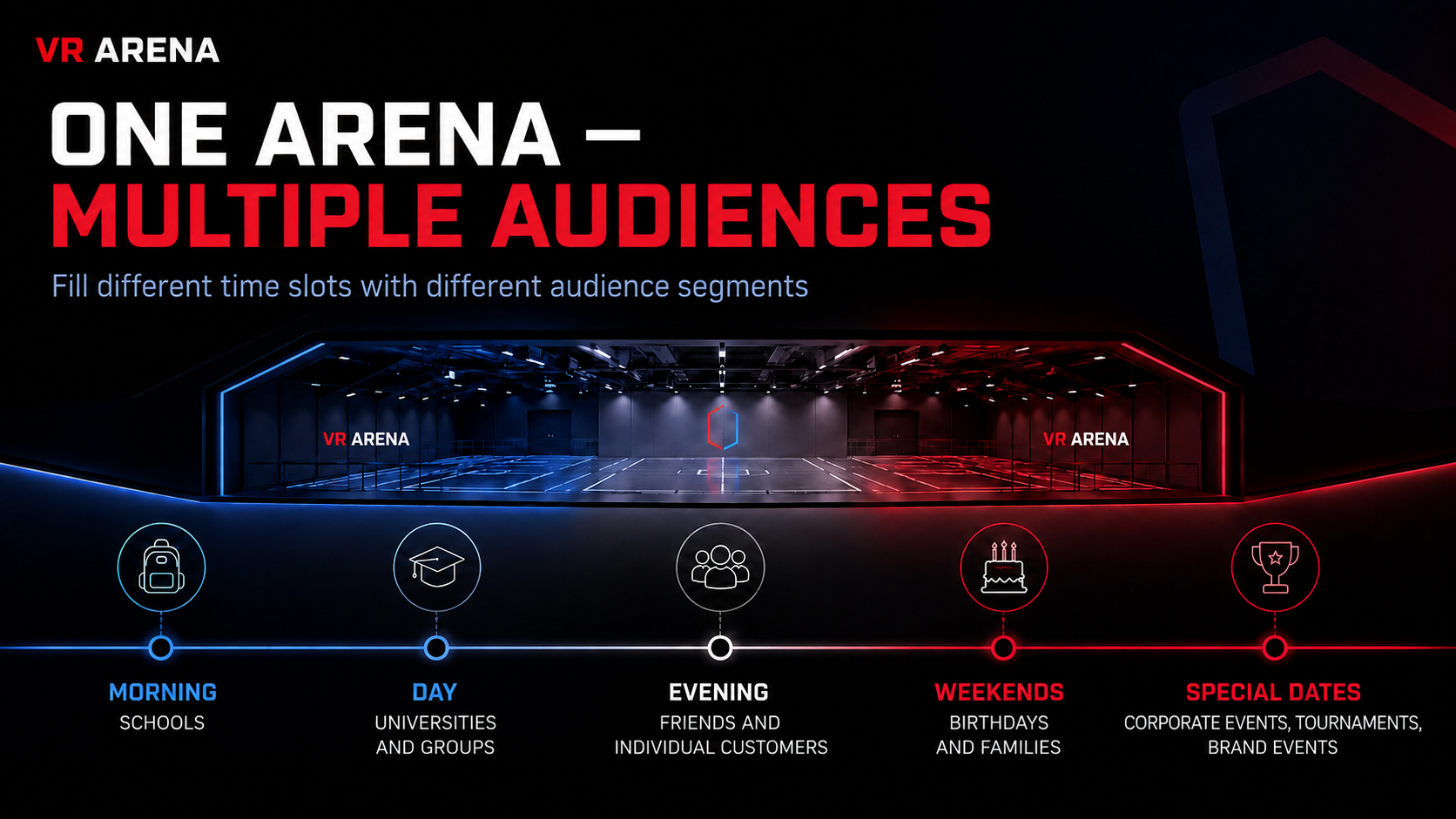
In the evening, that may be groups of friends. On weekends — birthday parties and families. In the morning — schools. During the day — student groups. On weekdays — corporate events. On selected dates — tournaments, branded events, and partnership activations.
Demand diversification is what allows a venue to become less dependent on evening and weekend traffic alone.
VR ARENA’s experience shows that systematic relationships with organizations can be more powerful than one-off promotions.
One school can return with new classes. One event agency can bring different corporate clients. One company, after a successful event, can make VR part of its annual program.
That is why reducing idle time does not start with another discount.
It starts with one question: who else can use our arena during the hours when the regular customer does not come?

